
The master-planned community (MPC) market is evolving, driven by changing buyer priorities, new regulatory landscapes, and emerging technology. RVi leaders from across the country share regional perspectives on what’s shaping communities today and where the next wave is headed. They include Brett Park, a Principal in Costa Mesa, California; Trent Rush, Senior Principal in Austin, Texas; and Ryan Seacrist, Vice President – Principal.
Heading into 2026, what major shifts or themes are you seeing in the MPC market? How do those differ from recent years?
Trent: In Texas, we’re seeing communities integrating more natural areas and shared spaces to promote wellness and social cohesion. “Agrihoods” are on the rise, and even par-3 golf courses are showing up as amenities, where you’ll have walking trails with a fun pitch-and-putt mixed in. We’re seeing innovative mixed-use developments with pods of build-to-rent (BTR) units—not BTR as a standalone community, but integrated within MPCs to provide buyers multiple product types.
Ryan: Permitting and regulation is impacting the way large-scale MPC developers approach budgets, curb appeal, and community aesthetics in Florida. New legislation is pushing counties and municipalities toward Florida-native landscaping and stricter water use. We’re already doing a lot of these things in our designs, but this extends to the type of sod being used and limiting exotic plants, which is a significant change in many jurisdictions. First and foremost, as landscape architects, we’re stewards of the environment. With that responsibility, we’re also helping clients adapt to regulatory changes by considering the impact on their brand and desired built environments.
Similar to Texas, the BTR horizontal apartment model has cooled down in demand in standalone setting in Florida, but we’re seeing it plugged into MPCs as well. Financing in this area has dropped off a bit, but traditional townhome rentals are still flying off the shelves.
Brett: In California, 2024 and 2025 have been pretty flat for MPCs. There’s some activity in Palm Springs and the I-15/I-215 triangle, but there’s really nothing coastal that’s active right now, mostly small infill parcels. Some MPC developers are partitioning off projects to multiple builders for a mix of architectural styles in their communities. The market that does exist is amenity-first. It’s less about home price and more about amenities. A lot of sports and recreational features are popping up, and those bring high upfront infrastructure costs.
High HOA fees are a big deterrent to buyers, and a lot of developers have moved into Utah, Arizona, Nevada—even Colorado and Texas. We’ve seen some BTR firms move their operations to Florida for the next business cycle.
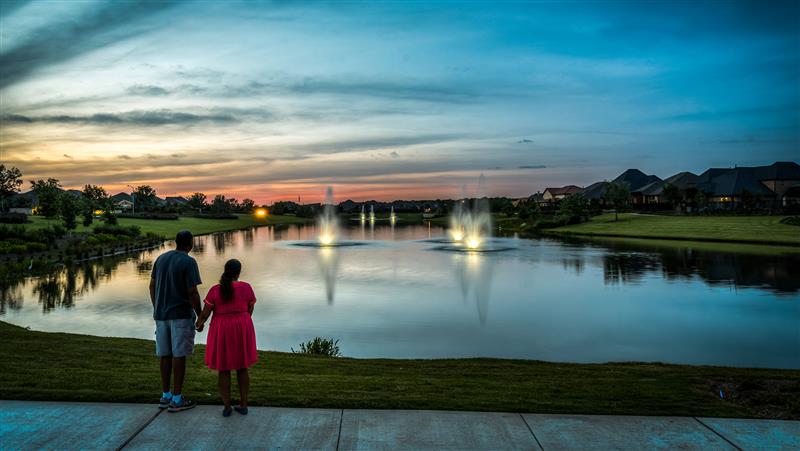
Meridiana – Brazoria County, TX
How are the trends you’re seeing impacting buyers and developers?
Trent: It’s amenity and experience first, with affordability being a key factor that impacts buyers. The younger buyer is focusing more on the emotion, the experience, and the features of the community. People aren’t driving as far to find a home anymore; they’re choosing smaller homes in lifestyle-rich infill areas. Private developers are focusing on brand building and investing in market and buyer research. There’s proof that brands sell.
Ryan: We’re seeing growth rebound around small municipalities on the fringe of larger MSAs with existing downtowns of a quaint and charming scale. The homebuyer cost is lower there, but there’s still a sense of place and community. We have multiple projects with a lifestyle-driven commercial town center as the anchor and core amenity investment. These communities are attracting a younger buyer profile that may be priced out of larger cities, like Orlando, but drawn to boutique communities, like Mount Dora. I think we’ll see that continue over the next 5 to 10 years. It differs from the typical leap-frog housing development pattern that is devoid of mixed land uses.
Brett: There’s a big movement in unique retail integration in California. We’re getting away from the corner store model and making retail experiences that showcase community character and an urban lifestyle. The barrier to entry is lower in these communities, and the lifestyle and retail areas are becoming more grassroots and localized, whether it’s fashion, food, coffee startups, or urban agriculture. Young entrepreneurial types can buy into affordable homes and then have opportunities within the community to be creative. Some of these are in the gestation period now, and they’ll expand in the next business cycle.
Are there any local factors, such as regulatory policies, land availability, or infrastructure that are impacting projects specific to your regions?
Trent: Infrastructure and utilities are big for Texas. We are seeing more and more developers forming municipal utility districts in rural areas and Austin’s outer rings to provide their own infrastructure, streets, and utilities, since the rural municipalities are not able to provide the needed infrastructure.
Ryan: We’re working on a couple projects in primarily suburban and rural counties, which are absorbing a lot of population expansion from the larger cities, like Orlando and Tampa. Development is moving quickly, and concurrency is a challenge. Developers are voluntarily offering land for municipalities to construct, for example, a wastewater package plant in exchange for impact fee reductions. If the municipality doesn’t use it within an argeed period time, it reverts back to the developer. This is just one way of encouraging and helping jurisdictions to keep pace with development. Many of the roads, too, are becoming privatized and managed by HOAs to relieve maintenance burden on cities and counties.
Brett: Water is a big issue in the Southwest, and fire is a high priority. Regulations around fire are predominant in every project, and people are leery because, in recent years, we’ve seen what the effects of fire management can be across the entire state. We’re always saying to overestimate for fire protection and provisions. Energy and power consumption is another major challenge as cities and counties work out how to distribute enough power to community members.
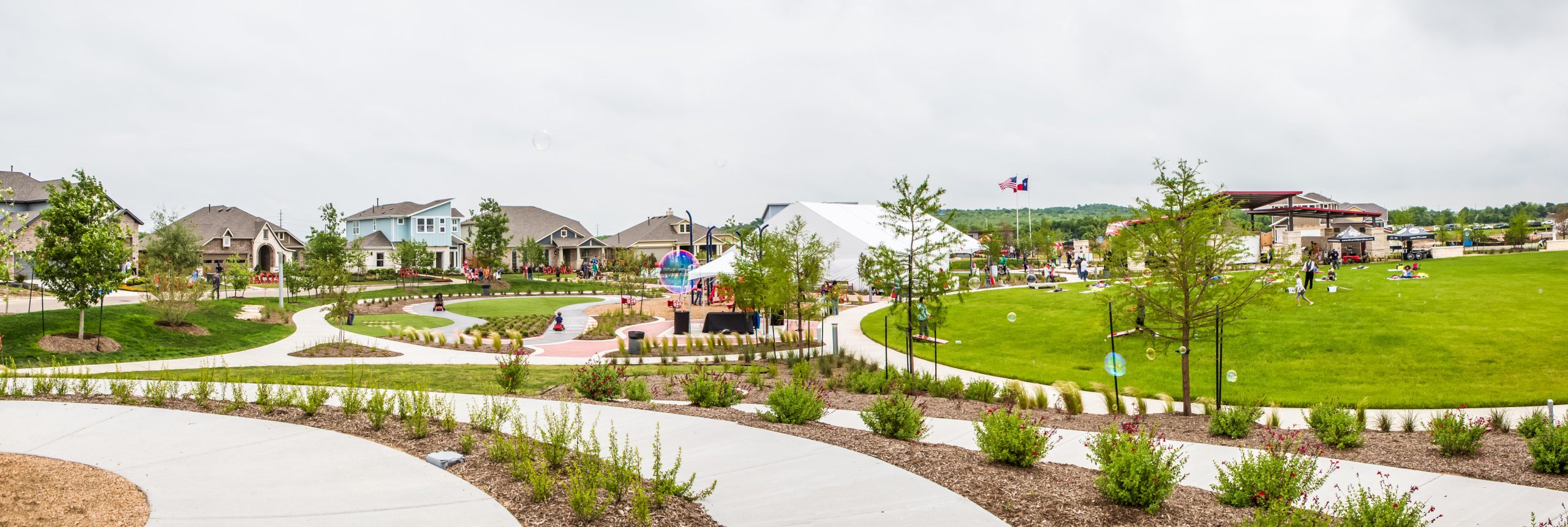
Easton Park – Austin, TX
What emerging innovations do you think will impact community planning over the next few years?
Brett: Large companies are using AI in increasingly sophisticated ways to plan very quickly while integrating in other aspects like financials, utilities and infrastructure, and the land planning. I think it will be very interesting to see how we, as consultants, adapt to the changing technological landscape
Trent: Simulations are getting very advanced, to where they can run them efficiently on multiple building types, layouts, and user profiles to understand all the scenarios. For developers, this can get you to construction sooner, but it still can’t shorten the municipal development process. I think it will allow us to read market cycles more precisely.
Ryan: With new technology and AI, there’s the issue of energy consumption. Some developments have already gone completely solar if they have the land to do it. For landscape architecture and other disciplines, we need to continue to be savvy with energy consumption in our designs.
How is RVi helping clients future-proof their projects for long-term resilience?
Brett: We always think about the end user, the people, and who’s buying in our communities. We make sure we’re in touch with multi-generational buyers. At the end of the day, we design for the people and the environment. We’re stewards of the land and of communities to ensure resilience and health in every sense of the term. Making sure places are walkable, bikeable, have good school systems and circulation—as long as we’re doing that we’ll always be at the forefront and putting people first.
Ryan: If we take a step back from the trends and fall back on principles, it’s not always about what’s next. It’s about the end user, what people need, and what the environment needs. We have to stay true to ourselves and not just do the next hot thing on the market because it’s there. We have to look at what’s going to be the most helpful to people and the environment moving forward.
Trent: In addition to end users, it’s about understanding the developer, their goals, their pro forma, and then helping them build a plan that supports their bottom line and provides a better community. We’re helping the end user—the buyer—but we’re also giving our clients, the developers, something they can be proud of.