
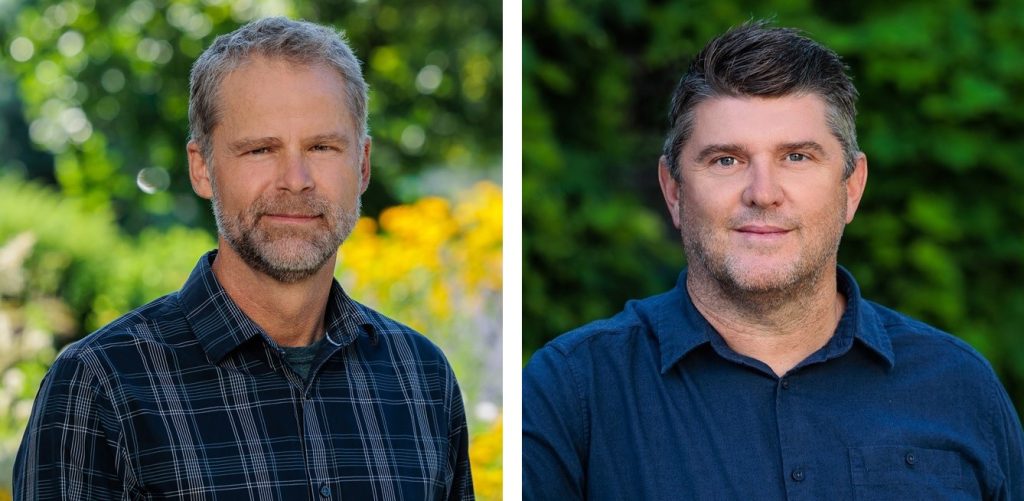
Craig Russell and Paul Mills are Principals at RVi, leading the Fort Collins and Denver offices in Colorado. The former co-owners of Russell + Mills Studios became part of the RVi team in August 2024, bringing their decades-long design experience and friendship to the firm. With a diverse portfolio of experience from campus planning to urban design, the two have a wealth of knowledge in Landscape Architecture.
In this Employee Spotlight, we learn more about their career journeys, favorite projects, and how landscape architecture can transform communities.
What inspired you to pursue a career in Landscape Architecture and Planning?
Craig: I was an outdoor kid; I loved roaming around outside. I’ve also loved drawing and designing from the time I was a kid. In college I studied biology and ecology, but I didn’t really know what job to pursue with that. My dad was a structural engineer at the time, and he was leasing office space from a landscape architect who owned the building. I’d go there to see my dad, but eventually wander over to talk to the landscape architect who would be making these big, colorful plans that looked really interesting. I liked how the work combined artistic creativity with technical design skills. He inspired me to look into a program at Colorado State University (CSU), and that’s how I got started. It felt like the best combination of biology, loving the outdoors, art, and design.
Paul: I’ve always been an artist. I started pursuing a degree in fine art but realized that I wanted more of a mental balance between my left brain and right brain. Then, I started exploring architecture, but I also felt like that had constraints. Finally, I met with some professors, and they recommended Landscape Architecture. I went to speak with the Landscape Architecture Department and thought it was really incredible, and that’s how I started.
What is a project you are particularly proud of in your career and why?
Craig: It’s been pretty cool to see the work we’ve done locally here in Fort Collins, and witness how people interact with it. We did an entire master plan framework and implemented numerous alleyway enhancements, and you can see this work and more if you walk around downtown. It was a series of different projects, but the connectedness of all of them is great to see. It’s nice seeing how the area is used now and how it’s opened new business opportunities.
Paul: That’s the joy of public work—seeing people use the spaces as you imagined and intended, and even seeing the space evolve over time.
Craig: Ruby Hill Park is another project we’re particularly proud of. Overall, it used to be seen as a dangerous area.
Paul: It’s a massive 90-acre park, and yet, it wasn’t a place where people wanted to hang out.
Craig: We were able to change the entire circulation system and really improve the level of safety, security, and comfort with a renovation of the entire park. People want to be there now. That had a major positive impact on the community.
Paul: We worked on the topography of the park, and we’d always thought it would be a great place for a stage and amphitheater. We were able to make it happen, and now there are about 50 free concerts a year through the Levitt Foundation, giving the community access to music and performances. It’s amazing to see that what started out as a little drawing on a master plan in 2010 has blossomed into a functioning, impactful facility.
Russell + Mills Studios has a legacy of award-winning campus planning and design work, especially in higher education. What are your favorite aspects of higher education campus work?
Craig: I like how we can improve human connection through features like bike paths, pedestrian paths, and areas for people to gather and hang out. We can also add character or define the identity of a campus. For example, at Colorado State University (CSU), we were able to change the look and character of the majority of the campus through our planning and design. We took out the grass and trees that were there and changed the whole landscape palette into something that looked and felt more like Colorado, using native plants.
Paul: The thing about university campuses is that you don’t really experience them unless you’re attending school or working there, so it’s interesting to see the final campus project and then revisit it again a few years later. We’ve done multiple projects on CSU’s campus, and I had the opportunity to show my family around when they visited from Australia a few years after we’d finished. It was beautiful to see how it all came together, and how well all the plants were growing.
What is one factor that differentiates higher education campus work from other project types?
Craig: Efficient circulation is important. You’ve got to consider that there are periods of high traffic with a large mass of people moving through the campus every hour. You also need a good understanding of how the project fits cohesively into the other features of the university.
Paul: University campuses are unique because thousands of people are living there—the campus is their front yard, their sidewalk, their home away from home. They should feel just as comfortable going to class on a weekday morning as they feel eating lunch on a Saturday afternoon or meeting up with friends or studying in a quiet corner. We need to create a sense of home.
Have you faced any significant challenges in your career? How did you overcome them?
Craig: Running our own firm was challenging, because so many people depend on you. You care deeply about your team. You feel a need to take care of everyone. You have to do all you can to bring in work because other people’s livelihoods depend on it.
Paul: And that can feel like a lot of pressure and stress. However, one thing we learned is to own up to your mistakes; people appreciate honesty. Take responsibility and move forward—I think our team and our clients really appreciate that.
What other valuable lessons have you learned working in Landscape Architecture?
Craig: Go the extra mile when you can. Treat every client like they’re the most important. Don’t dwell on disagreements or problems; always look for the best way forward.
Paul: Be tenacious and passionate about your work. We always aim to make sure our projects are not half-baked or just “good enough.” It’s easy to be average because you don’t have to work as hard. But we put a lot of passion and hard work into what we do.
Are there any specific professional goals or aspirations that you are working toward?
Craig: Continuing to build a cohesive structure at RVi as we integrate the former Lakewood office with the Denver office. We also want to use our experiences in policy planning to grow public sector work, specifically in park experiences that connect people with nature.
Paul: We want to continue to elevate our designs and the way we approach projects. With our teams combining, I feel like we’ll have many great opportunities opening for us in the future.


Loved getting to know you better! Your work sounds amazing and very happy to have you a part of RVi!