
Tim Bargainer, Senior Vice President of Public Markets at RVi, shares reflections on how sustainability, resilience, and the mindset of environmental stewardship have shaped his work and leadership across his decades of experience in landscape architecture and planning.
There’s a word we use often in design, but don’t always stop to define: stewardship.
It shows up in mission statements, sustainability goals, and design guidelines. But to me, stewardship is more personal. It’s responsibility without ownership. It’s the act of shaping places that serve communities, ecosystems, and future generations in ways we may never fully see.
In landscape architecture, stewardship is not an add-on, it’s the work. Whether in the public sector or private development, we’re expected to balance ecology and access, protect the land, and build systems that last. This is where sustainability and resilience meet. We don’t just want to reduce impact; we want to create places that have environmental, social, and cultural longevity.
I’ve spent most of my career working in the public sector throughout the South, focusing on trails, parks, streetscapes, downtowns, campuses, and regional networks. Some of the projects we built more than 20 years ago are still evolving today. The ones that endured weren’t necessarily the flashiest. They were rooted in deeper thinking and a sense of responsibility and stewardship to the land and the people.
Now, in the later years of my career, I’m less focused on what I’ve built and more on what I’m contributing to the future. Because if the work we’re doing really matters, then we should be designing like it does.
Sustainability is a Baseline, Not a Bonus
“We can’t keep building against nature. We have to start building with it.”
— Kate Orff, award-winning landscape architect
Sustainability should never be a feature we add in later. It needs to be the starting point.
Firms today are branding sustainable approaches, tracking metrics, and aligning with certifications like LEED and SITES. It’s a sign that our industry is serious about environmental stewardship. More than ever, we want to show that what we design makes a difference. But sustainability isn’t about chasing labels. It’s about respecting the land, using resources wisely, and minimizing long-term maintenance.
I’ve always believed that design decisions should match the scale of their impact. If a trail runs through a floodplain, it should be designed with the water in mind. If an urban plaza faces extreme heat, then shade and materials matter as much as the paving. If we’re shaping a district or a park, we should have early conversations about plant palettes, wildlife corridors, and resource longevity. This kind of thinking doesn’t need to be flashy. It just needs to be intentional.
When projects are grounded in sustainability, they hold up. Native or adapted plants thrive when matched with the right soil and amount of sun. Water managed through grading or bioretention is more resilient than complex systems. Materials chosen for durability and climate responsiveness age with grace. These choices don’t just serve opening day; they support long term stewardship.
I have seen this approach work across many different contexts in projects that I’ve been a part of with the RVi team. At Mueller in Austin, the Southeast Greenway is part of a broader park and trail network. But it’s also a stormwater system and a regional habitat corridor. The pond at its center supports water quality and ecosystem health. The story it tells is simple: technical performance and ecological value can live side by side.
At the New Belgium Brewery in Asheville, a former brownfield was transformed into a landscape that filters runoff, supports habitat, and welcomes thousands of people each year. Bioretention, native planting, and public access are all integrated into a functioning industrial campus. The result is a place that reflects values, not trends. The stewardship is built in, not applied on top.
These projects work not because they won awards, but because they were designed with care and with a long view. They remind us that sustainability is not a look, but a way of thinking and building.
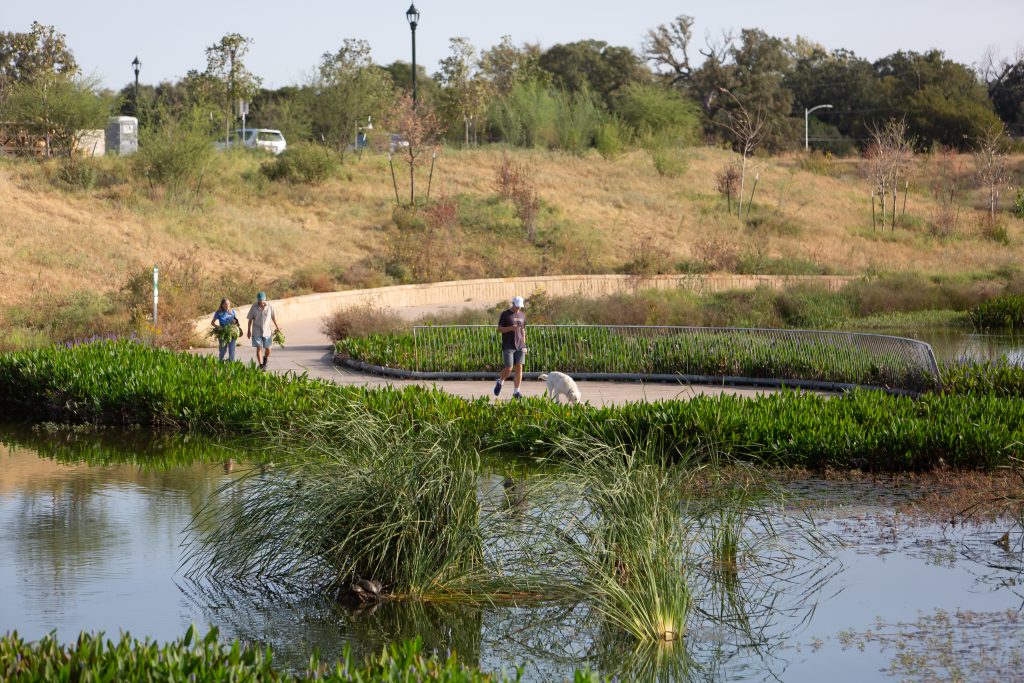
The Southeast Greenway at Mueller in Austin, Texas.
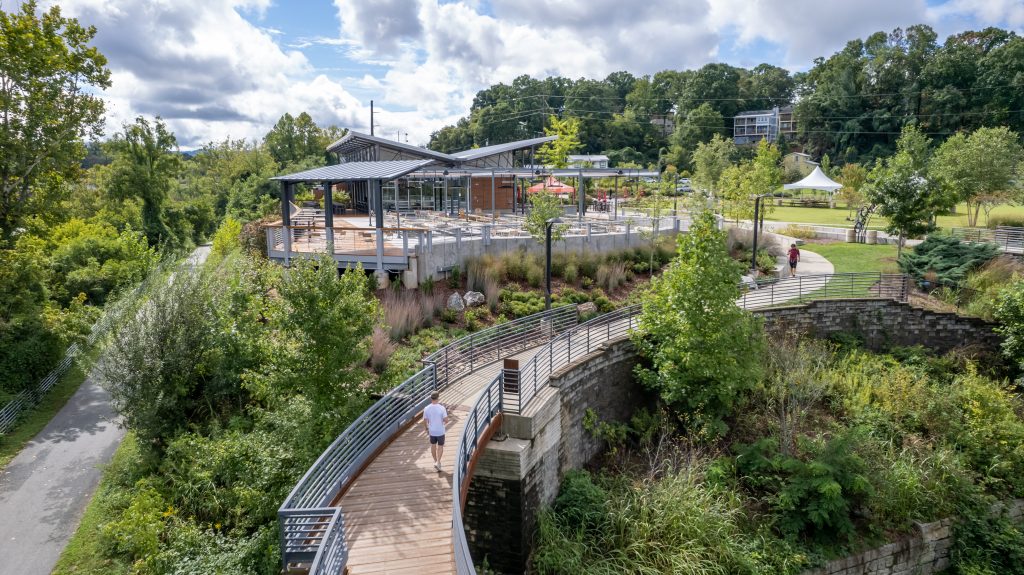
New Belgium Brewery in Asheville, North Carolina.
Resilience is No Longer Optional
While sustainability helps us reduce impact, resilience helps us recover from it. Resilience is no longer a design feature—it’s the expectation.
Public projects today must prepare for hotter summers, stronger storms, tighter budgets, and shifting uses. This means asking better questions early on: Can this place absorb stress? Can it adapt over time? Can it recover from weather events without major reconstruction?
We’re already seeing these challenges everywhere. Parks designed 10 or 15 years ago are now serving as stormwater detention areas, cooling zones, or emergency staging areas. Trails double as transportation corridors and evacuation routes. The public realm is carrying more responsibility than ever, and it needs to be designed to meet that demand.
Resilient design is flexible. It doesn’t lock itself into a single use; it can adapt. That might mean planning open lawn spaces that double as event areas and detention, or designing park infrastructure to withstand submersion. Often, it means letting the land lead the layout—not the other way around.
Resilience also means honoring natural systems. When we work with existing topography, hydrology, and vegetation, we are less likely to overbuild and more likely to create something that lasts. Designing with nature is as poetic as it is practical.
And just like sustainability, resilience is both ecological and cultural. It’s about how we engage people, how we reflect identity, and how we support the ability of communities to recover and reconnect after hardship. This also requires a level of flexibility, in understanding different perspectives, adjusting to changing norms and regulations, and keeping people connected to their communities.
As designers of public spaces, we are not just shaping amenities; we are shaping infrastructure. And that infrastructure needs to stand up to pressure. The projects we deliver should help communities bond when things get hard. That’s a different kind of aesthetic, one that isn’t always seen on opening day, but becomes clear over time.
Resilience is no longer an option. It’s the standard we should be designing toward. If we are serious about stewardship, then we cannot just build for today–we must prepare for tomorrow.
Stewardship as Leadership and Legacy
Stewardship isn’t just about how we design. It is about how we lead.
I was fortunate to have mentors who taught me to value long-term thinking over short-term recognition. They were my examples of how to navigate the complexity of public work with humility, purpose, and patience. Now, I try to pass those lessons on by sharing what I’ve learned and by trusting younger staff to lead, make decisions, and grow into their own voice.
This includes teaching young professionals that our work is more than winning proposals or designing beautiful parks. We must show them how to listen before they create, how to work with communities instead of just designing for them, and how to see sustainability and resilience as responsibilities and not trends.
It also means being honest and transparent about the challenges. This work isn’t always easy; it can be slow, political, underfunded, and misunderstood. But when done well, it has a huge impact on real people and real places. That’s worth the effort, and that’s a lesson worth passing along.
In the later years of a career, it’s easy to focus on what we’ve built. But the real legacy isn’t the projects; it’s the people we’ve shaped along the way. If we want the places we create to last, we have to help others understand what it takes to keep them meaningful.
At this point in my career, I still care deeply about great design. But I care even more about helping others understand what great design truly means. It’s the thinking behind the design; the choices, the values, and the willingness to take the long view. It’s also about telling a better story through design, one that reflects purpose through every detail. When we curate experiences with that kind of care, people feel the difference, even if they don’t see the structure behind it.
A Stewardship Mindset is the Guiding Light for Our Work
Stewardship is not a title, a task or even a set of metrics. It is a mindset. And in our profession, it might be the most important thing we can model for those who will follow.
A quote from American philosopher, scientist, and environmentalist Aldo Leopold still resonates with me to this day: “We abuse land because we regard it as a commodity belonging to us. When we see land as a community to which we belong, we may begin to use it with love and respect.”
If we want the places we shape to endure, then we need to prepare the people who will design what comes next. That’s the real measure of legacy, not just in what we build, but in what we pass on. Because if we believe the work truly matters, then we have to keep designing like it does.


This description of stewardship resonates with me, and, a rare find when truly embraced.