
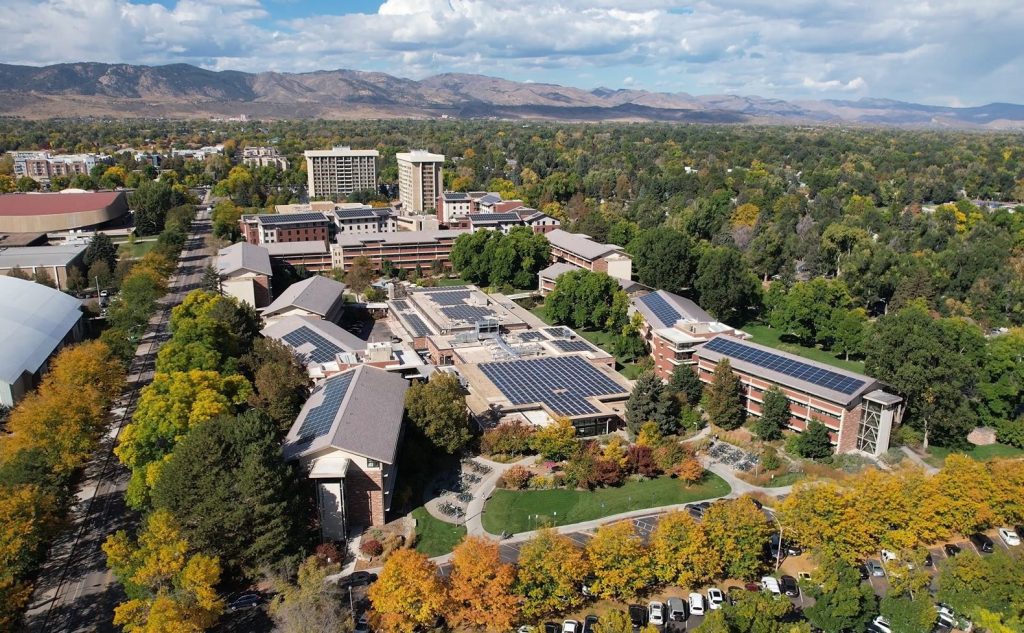
Colorado State University’s (CSU) student housing facilities were first designed and constructed in the 1960s. As the university’s population, technology, and environment grew and evolved, its student housing did not. Circulation challenges, limited outdoor amenities, and a lack of character were key issues that CSU Housing and Dining Services wanted to address. CSU engaged RVi (then Russell + Mills Studios) to lead a total renovation that would increase the quantity and quality of campus housing while creating an authentic Colorado aesthetic and a sense of home.
Craig Russell, RVi Principal, led the team that brought CSU’s vision of a modern, sustainable, and cohesive student housing community to life. What were originally three separate student housing facilities were transformed into the North Housing District: a 21-acre site that includes the three renovated facilities and a new 900-bed student housing complex called Laurel Village, earning LEED Gold and Platinum certifications.
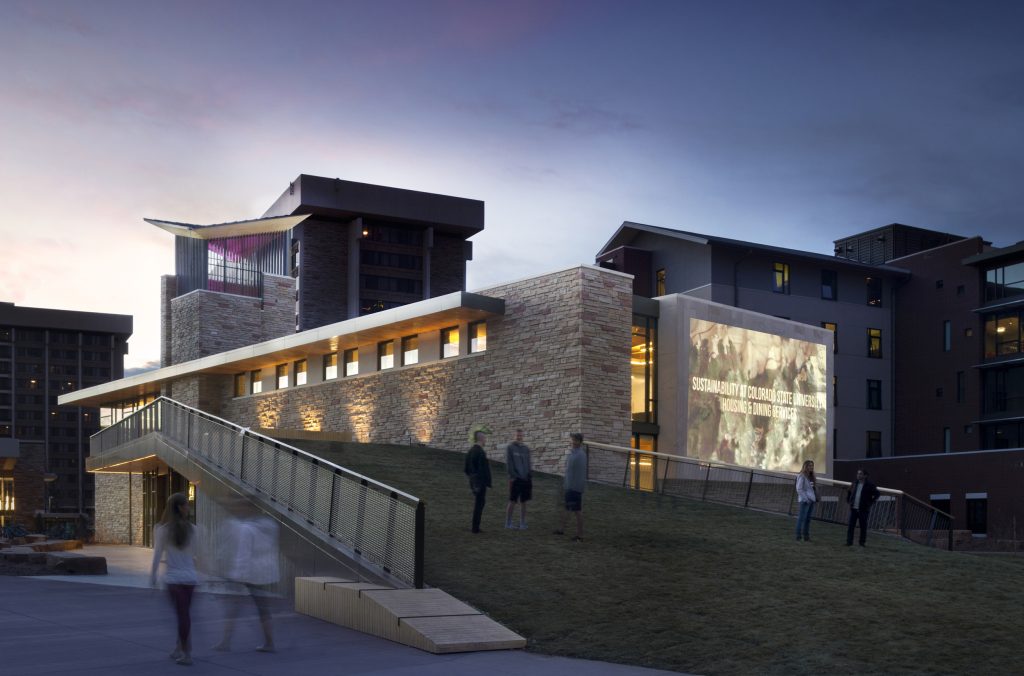
The Laurel Village Pavilion has won multiple awards for its sustainable features and outdoor design.
Designing a landscape where the old could cohesively exist with the new
Planning for the project began in 2013. The team conducted numerous site analyses, examining the conditions and circulation patterns of the campus while determining how to build around already-existing structures.
“Our goal was to take existing student housing, renovate it, add a new student housing complex within that matrix of buildings, and weave it all together in a site that creates efficient flow to the core of the campus,” Craig stated. “We wanted to create a cohesive and consistent sense of place in both indoor and outdoor spaces.”
Visualization tools, such as sketches, 3-D models, and vivid illustrations were vital in communicating the details of the project to the client and gaining stakeholder trust in the team’s vision. Altogether, the team developed a site master plan, planting plan, grading and drainage solutions, construction documents and administration, and viewshed analyses. They also collaborated with architects to develop a site master plan for the new Laurel Village Student Housing complex.
Creating a home away from home for 2,500 students
The area that would become the North Housing District would house about 2,500 students. The team worked closely with CSU Housing and Dining Services to ensure that critical design considerations were implemented, such as circulation, parking, and water conservation.
For circulation planning, a hierarchy of village-style pathways were designed to accommodate large numbers of people, as well as bikes.
“CSU is unique because about 80% of the student population rides bikes, so bike paths and bike parking are a big deal,” Craig commented. “We made sure to design pedestrian and bike paths that created a better flow in a safe manner. This housing district would hold 2.5-times more students than it did before. With so many people concentrated to this one area of the campus, it was important to create efficient pathways that led to the core of the campus, as well as effective parking areas.”
Dining and food services, waste management, and site programming events and training areas also had to be considered when planning the site.
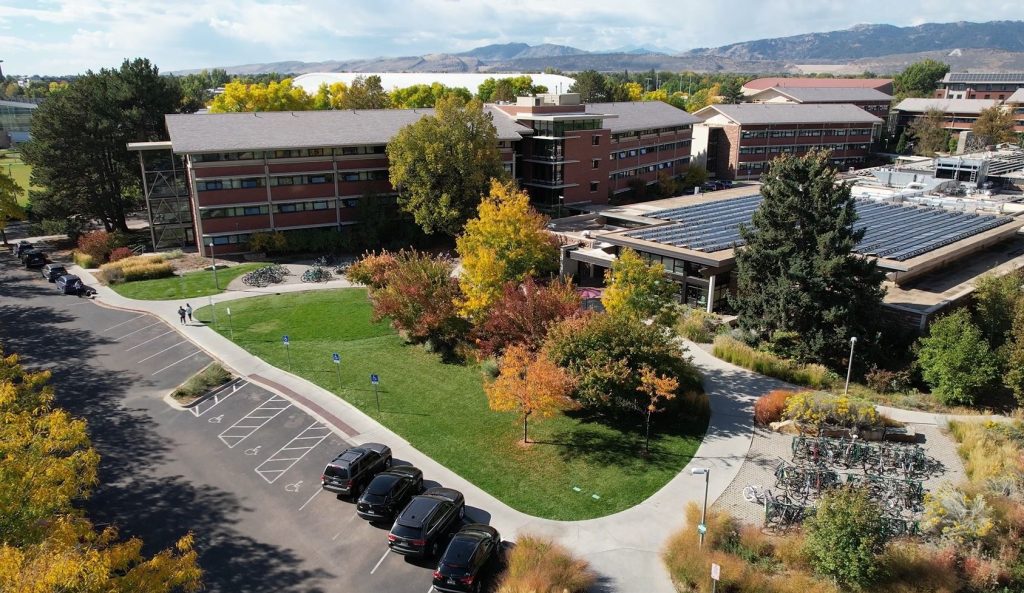
Pedestrian pathways, bike paths, and parking for cars and bikes were important considerations for improving circulation.
Infusing the essence of the Colorado Foothills into the site
There were a few challenging aspects to the project, like the grading and drainage. There were also a lot of existing trees and components to work around and integrate into the design. However, the team achieved a beautiful end result: A scenic, sustainable, authentic Colorado landscape that students could actively enjoy.
It was important to the client that the landscape created a strong sense of place, helping students feel connected to the Colorado terrain. This was achieved by incorporating plants and materials based on the features of the Colorado Foothills, such as locally sourced boulders, cobble, and native plants.
“We visited the nearby Colorado Foothills, which lead to the mountains, and referenced the palette of that landscape,” Craig explained. “We wanted the housing district to look and feel like Colorado, not just a generic American town—that’s a major attraction for students who attend CSU. We planted and weaved these elements together around the site, in fire pit spaces, amphitheaters, plazas, courtyards, and hills and mounds where people could just sit and relax.”
The locally sourced materials also served as sustainable and low-impact stormwater solutions, improving the quality of water and water conservation. Irrigation zoning strategies and the elimination of underutilized lawn areas also helped with water conservation.
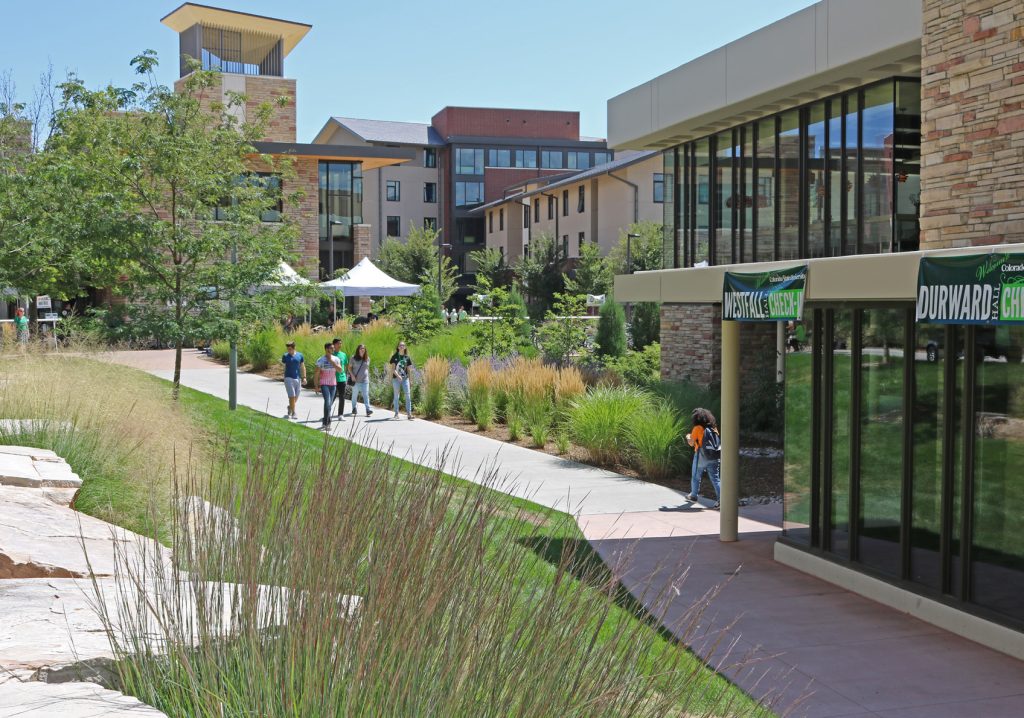
Grading solutions helped rectify moat-like areas, transforming them into scenic pathways with native Colorado landscape features.
Appreciation and recognition from faculty, students, staff, and beyond
Since the North Housing District’s completion in 2018, Craig has seen firsthand how the updated landscape architecture has positively affected the campus community.
“We wanted to create a sense of place where students would visit and want to come back, or better yet, stay,” he said. “Whenever I visit, I always see a lot of students outside of the dorms, not just in them, which is great sign that our goal was accomplished.”
The project also earned LEED Gold and LEED Platinum certifications in 2015 for the Laurel Village and the Laurel Village Pavilion. The Laurel Village Pavilion was also recognized with a Society for College and University Planning (SCUP) Excellence Award in 2017 and earned an Urban Design Award in Sustainable Design from the City of Fort Collins in 2019.
“The buildings are now equipped with solar panels, a passive katabatic cooling tower, and Trombe Parapet, which was made possible due to us creating the necessary infrastructure associated with photovoltaic cells and other sustainable features,” stated Craig.
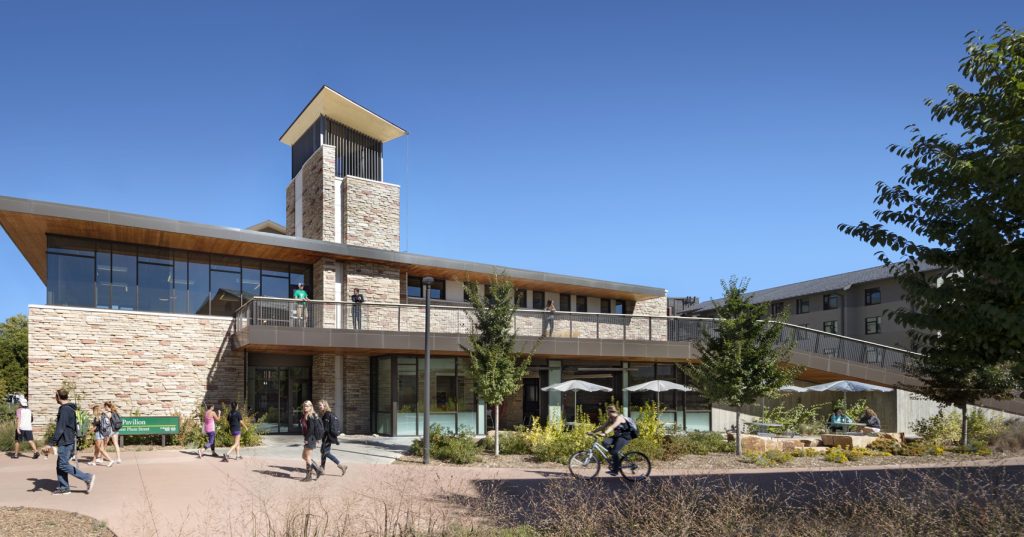
The Pavilion’s Katabatic Tower (seen above) uses evaporative cooling and natural convection to regulate the building’s temperature.
Reverence and respect for landscape architecture drove the success of the North Housing District
The North Housing District was designed with a variety of spatial types so that students would have multiple uses for the landscape. A combination of intimate spaces, medium-sized gathering spaces, event spaces, and recreational spaces sets the campus apart from others.
“CSU Housing and Dining Services saw this housing district as an opportunity to showcase the landscape and make it an active part of the campus,” Craig said. “CSU recognized that the landscape matters to the people who would be living there, and that it’s more than just a backdrop for the buildings. We were fortunate to have a client that believed that a great landscape is important, too.”