
By: Kristine Gay, Project Manager
Every fall, hundreds of bike enthusiasts watch as the world’s top freeride mountain bikers drop from 50-foot cliffs, launch across 70-foot canyon gaps, and perform an array of flips and tricks. The Red Bull Rampage competition has become one of the biggest events in the biking community. In 2023, the event was held just outside of Virgin, Utah, amongst a beautiful backdrop of sandstone cliffs.
Due to the nature of the competition, it requires terrain with diverse landforms, such as mountains, canyons, and cliffs. It also requires space, which means the competition is often held in remote locations away from nearby homes or towns.
The competition brings business to the rural areas that host it, while providing a place for bike enthusiasts to commune, compete, and connect with environments they may not normally get to experience. Careful land use planning and considerations can support the ability for events like this to take place.
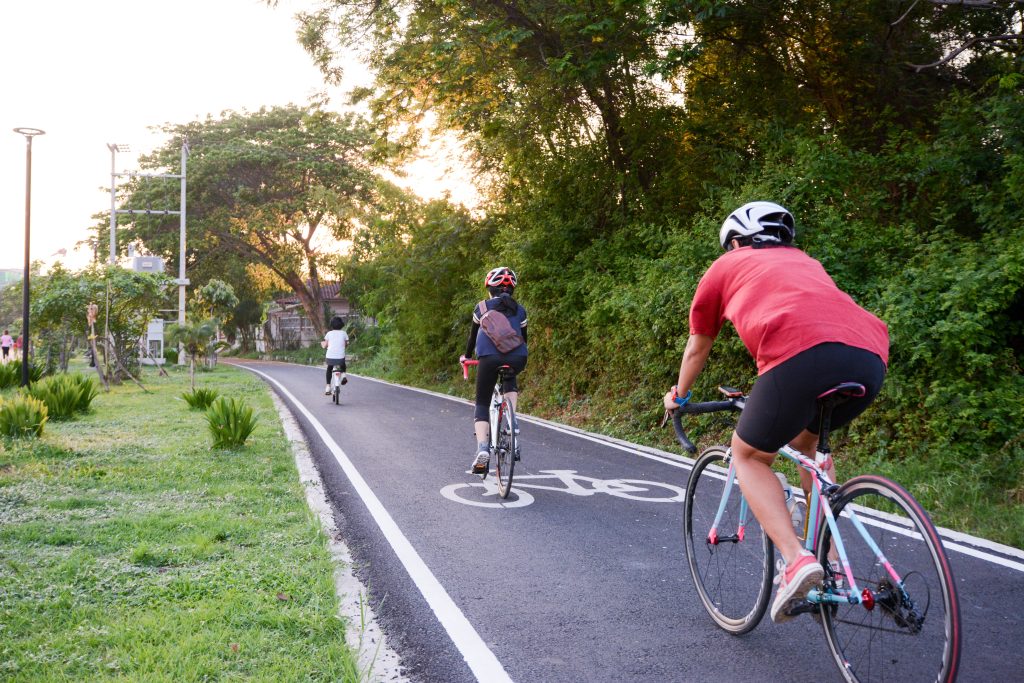
Of course, not all bike events or trails are as extreme or remote as Red Bull Rampage. Many are intentionally integrated into urban areas, can connect rural communities, and aren’t just for professional bikers, but for everyone in the community. Landscape architecture and design are the key to building communities that embrace bikes.
April is World Landscape Architecture Month, and in honor of this observance I want to highlight the positive impact landscape architecture design has on bike-centric communities, and how those communities impact residents, the environment, and the economy.
Bike paths provide safety, sustainability, and function: Babcock Ranch
Located in southern Florida, Babcock Ranch is a master-planned community developed by RVi client Kitson & Partners. Over the years, RVi has contributed to its landscape architecture design in the form of public parks, streetscapes, and neighborhood schools. As the neighborhood grew and more schools needed to be built, student safety became a big concern with school representatives. Many children walk and ride their bikes to school. RVi staff put a lot of careful planning into the landscape at the front of the schools, incorporating vehicular barriers in the form of trees, landscapes, and ranch fencing, preventing cars from driving through the main pedestrian areas and bike paths leading up to the school.
By locating the vehicular access points elsewhere on the site and substantially separating the bike and pedestrian routes from drive aisles, students are able to seamlessly walk or bike to school without encountering conflict points with vehicles. Without these careful landscape design considerations, this area would have seen the most vehicle traffic and young students would be burdened with navigating through distracted and rushed drivers.
Beyond enhancing the physical safety of students, a number of other positive outcomes occur when children can safely walk or bike to school, from health benefits to decreased stress. This goes to show the far-reaching positive impact that sound landscape architecture and planning can have on communities.
Bike-centric amenities are a desired addition to parks and green spaces: Beverly S. Sheffield NW District Park
The City of Austin Parks and Recreation Department tapped RVi to create a vision plan to update the Beverly S. Sheffield Park. This plan heavily relied on community engagement and input, which RVi facilitated. One of the top goals the community wanted to see in the park was enhanced and increased recreational amenities—and a bike park was a highly anticipated addition.
Bike parks appear to be experiencing a resurgence within public spaces over the last decade. Asphalt and concrete pump tracks are increasingly requested by residents. Contrary to the aged perception that pump tracks are taken over by unruly teenagers, pre-school and elementary-age children on scooters and balance bikes often out number teenagers and adults. Designing spaces for bikes within public parks provides a safer opportunity for riders of all ages to learn or improve upon their biking skills and to meet neighbors who share their interest in biking.
When communities pass on the chance to include bike parks as part of public recreation spaces, they indirectly discourage the use of bikes for recreation, fellowship, and transportation, resulting in missed opportunities for enhanced health, community engagement, and resident satisfaction.
Intentional design for biking encourages better physical health and social connection: Mueller – Austin, Texas
While temporary events set the stage for communities to embrace bikes, some communities are intentionally designed to encourage the use of bikes for commuting and recreation. Mueller is one such community. Mueller is a planned bicyclist and pedestrian oriented mixed-use community located in Austin, Texas, that was intentionally designed to encourage the use of bikes for commuting and recreation. RVi has served as the landscape architect for this 700-acre project developed by Catellus Development Corporation in partnership with the City of Austin.
Over twenty percent of the Mueller community is comprised of open spaces, including a green “necklace” of over 75 acres of continuous linear greenways along the community’s perimeter. This includes a continuous seven-mile circuit of a ten-foot wide hike and bike trails serves as the functional connection of this prominent greenway system. This looping trail and open space system connects Mueller residents, as well as the public, to a number of open spaces, parks, neighborhoods, transit stops, as well as commercial, office, and civic uses located within and around Mueller.
This system also connects to Texas’s first ever concrete “pump track.” A pump track is a rolling path with banked curves that is intentionally designed for riders to pump the pedals of their bike to build and maintain momentum. Generally, pump tracks were typically made of dirt, but in recent times they are commonly comprised of asphalt or concrete. Pump tracks and skate parks are being increasingly embraced by communities for multiple reasons: they are a supportive community amenity for many kinds of people, from seasoned bikers to beginners, adults and teenagers, as well as parents with young children on Stryder bikes and scooters.
For bike-centric communities to be successful, you must also consider those who don’t ride bikes
For bike infrastructure to be truly embraced by a community, an array of seemingly non-bike-related components must also be planned for. The mixed-use and medium to high residential density of Mueller limited the size of residential lots to support the use of shared open spaces. These factors affected the location of bike trails and how convenient those locations were. Careful parking provisions accommodate car drivers while preventing high speed arterials and parking lots from dominating the area. Private driveway access is provided to homes from shared alleys instead of repeating along the neighborhood street, decreasing the hazard of drivers reversing into the path of bicyclists. Roadways located intentionally along the greenways provides public on-street parking near trails and ensures there is an “activated” edge during quieter park hours to increase the feeling of safety for trails and park users while providing convenient access to trails.
These bike-oriented design choices contributed to Mueller becoming the first neighborhood in Texas, and the largest neighborhood in the world, to be recognized by the United States Green Building Council (USGBC) as being Stage 3 LEED-ND (Leadership in Energy and Environmental Design – Neighborhood Design) Gold Certified, increasing the city and state’s reputation and attracting prospective residents from around the country.
Conclusion
Incorporating bicycles into the design of communities offers multifaceted benefits, fostering healthier lifestyles, supporting reduced traffic congestion, and encouraging community engagement of shared interests. By integrating bike-friendly infrastructure, such as protected bike lanes, clear effective signage, and safe and convenient bike racks, communities can enhance accessibility and connectivity for a wider demographic. Investing in bike-specific park amenities and embracing bike culture improves public health, cultivates a sense of community and livability, and makes neighborhoods more vibrant and enjoyable places to live. When incorporated into urban planning, biking is not just a mode of transportation, but a catalyst for creating happier, healthier, and more resilient communities.